
Highlights
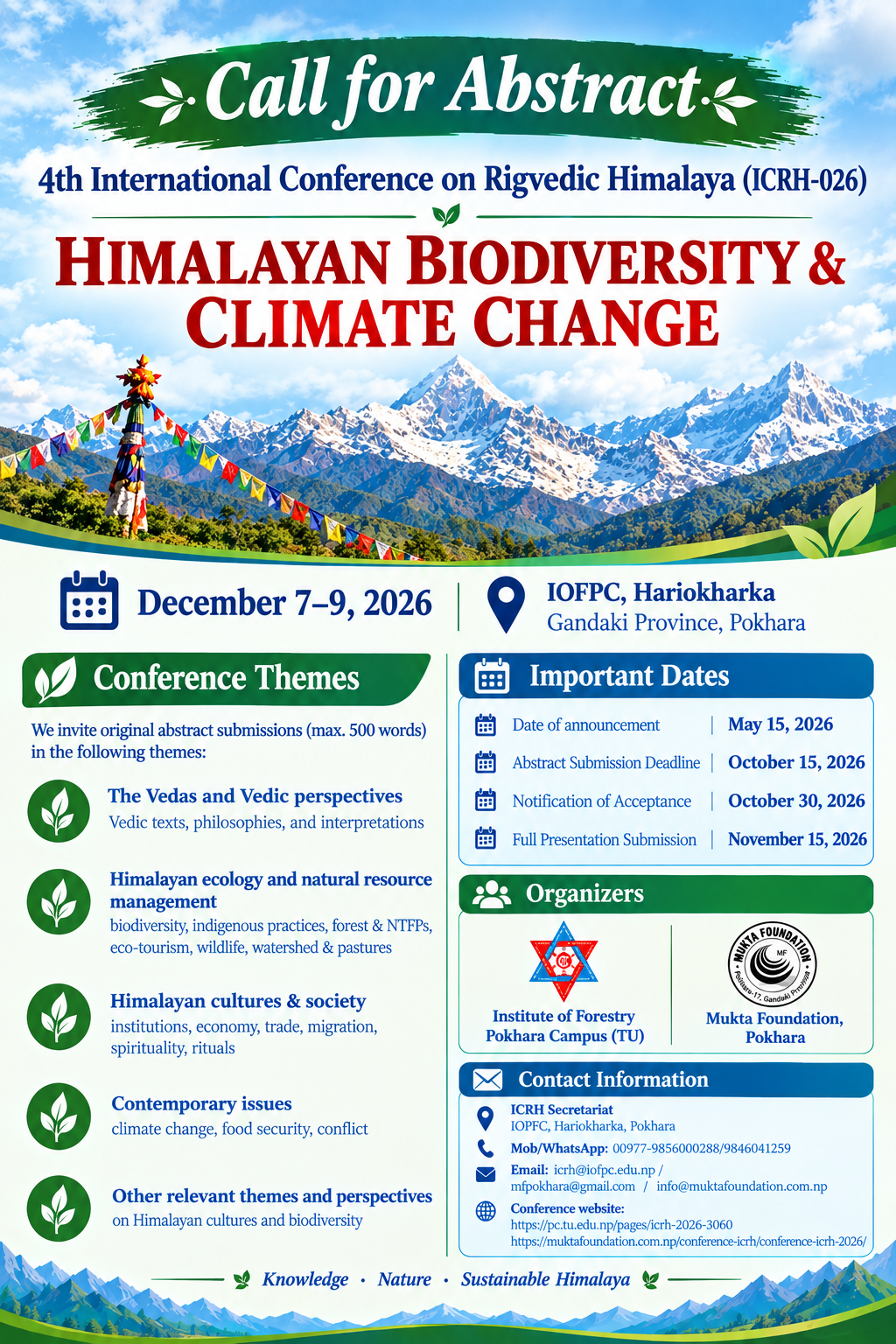 The 4th International Conference on Rigvedic Himalaya (ICRH), 2026 offers an optimal platform for academic exchange, interdisciplinary dialogue, and scholarly inspiration among experts and emerging researchers in the themes and perspectives on the Vedas, the Himalayan ecology and cultures spanning from humanities to social and environmental sciences. Based on past experiences, ICRH specifically foregrounds Rigvedic references to the ecology and way of life of the Himalayan communities, bridging ancient textual traditions with contemporary environmental and cultural challenges. This year, ICRH-2026 is organized under the theme "Himalayan Biodiversity & Climate Change" that brings attention to the the heart of the Himalayan ecosystem, with emphasis on its cultural, spiritual, and ecological significance and climate change as a pressing issue of national and global concern.
The ICRH-2026 is organized by Institute of Forestry Pokhara Campus (IOFPC) and Mukta Foundation, Pokhara within the framework of a formal five-year Memorandum of Understanding (MoU) signed between the institutions in November 26, 2025. It will be held at the Institute of Forestry, Pokhara Campus, in Hariokharka Pokhara, from December 7–9, 2026 situated in in the foothills of the Annapurna massif and the Mt. Machapuchhre. The campus is located in Pokhara which is the capital of Gandaki Province, approximately 200 km west of Kathmandu and 210 km north of Lumbini (the birthplace of Lord Buddha) by road. As the province’s largest city, Pokhara serves as its major administrative, commercial, and economic hub. Recognized as Nepal’s tourism capital, the city lies in a valley flanked by lush green hills to the south and snow-capped Himalayan peaks to the north. Pokhara is also renowned for its lakes, rivers, and diverse cultural heritage sites representing both Hindu and Buddhist traditions.
Conference Vision
The Rigvedic Himalaya (RH) initiative proposes an integrated cultural–ecological framework for understanding the Himalayan region of entire South Asia and beyond. It posits that the Himalaya is not merely a geographical space but possesses a unique ecology and "Living Archive" where physical survival, cultural identity, and spiritual fulfillment are inextricably linked. Building on the success of the first three series (ICRH-023, ICRH-024 & ICRH-025), the 4th ICRH-026 invites scholars, scientists, and practitioners to explore the intersections of Vedic philosophy, indigenous knowledge systems, and environmental sciences to comprehend and tackle the contemporary local and global challenges.
As a conceptual framework, Rigvedic Himalaya (RH) seeks to examine the underlying ecological and cultural principles, values, and norms through which Himalayan societies understand, use, manage, and relate to their natural environment. It approaches Himalayan ecology and cultures as an interconnected whole, rather than as separate domains. Central to this perspective is the understanding that Himalayan cultures are living ways of life, shaped by the continuous effort to maintain a balance between human existence and the natural world. Thus, RH is concerned not only with how resources are managed, but also with the cultural meanings, ethical principles, and ecological relationships that guide such practices.
Thematic Areas for Submission
We invite original abstract submissions (max. 500 words). Submissions that address the following or related subjects through interdisciplinary lenses:
Submission Guidelines
(a) Rigvedic Himalaya: Journal of Vedic Perspectives & Himalayan Cultures (ISSN: 3059-9431) published by Mukta Foundation
(b) Journal of Forest & Natural Resources Management (ISSN 2681-6424) published by IOFPC.
Important Dates (Revised)
Registration & Modality
The ICRH will feature keynote addresses, thematic lectures, paper presentations, poster presentations, and policy dialogues. Field visits to a culturally and ecologically significant site in the Pokhara valley will be organized for the registered participants and speakers.
Registration opening: August 15, 2026
Early bird registration: October 30, 2026
Registration close: November 20, 2026
|
ICRH-026 Registration* |
Early Bird Fee (NRS) |
Regular Fee (NRS) |
|
Member** |
1K |
3K |
|
Non-Member |
2K |
4K |
|
Student |
1K |
2K |
*For residential participant Rs 2K is added in the given list.
scan for ICRH-026 Registration Form

**Member: Advisors and members of ICRH, member of Mukta Foundation, faculties and staff of IOFPC, and limited participants from sponsors and supporting institutions.
Dear all participants!
Pls scan the QR and fill the registration form
Contact Information
ICRH Secretariat
IOPFC, Hariokharka, Pokhara
Mob/WhatsApp: 00977-9856000288/9856027224
Email: icrh@iofpc.edu.np / mfpokhara@gmail.com /info@muktafoundation.com.np
Website (IOFPC): https://pc.tu.edu.np/pages/icrh-2026-3060
Website : https://muktafoundation.com.np/conference-icrh/conference-icrh-2026/